Information for patients
If you are a patient reading this and have a concern about an MRI scan you are scheduled to attend, we strongly recommend you contact the site where your scan is due to take place, you may also wish to refer to our ‘Information for Patients’ section. Please note local variations to the policies detailed on this website may apply, therefore please contact the hospital where your appointment is scheduled for clarification.
Disclaimer (MUST READ)
The MRI safety information contained within this webpage is intended for use by staff from NHS Greater Glasgow and Clyde (GGC) and associated health boards, namely: NHS Ayrshire and Arran, NHS Borders, NHS Dumfries & Galloway, NHS Forth Valley, NHS Golden Jubilee, and NHS Lanarkshire. Only staff from these health boards are approved to use this information and local variations to the policies detailed may apply. Non-approved users i.e. patients and staff from health boards other than those listed above, or staff from private medical organisations use this information at their own risk. We, NHS GGC, accept no responsibility for patient injury or adverse outcomes that may occur as a consequence of the information contained herein. If you have any questions regarding this disclaimer, please contact the NHS GGC MRI physics team on: ggc.MRSafetyExpert@nhs.scot.
What the procedure covers:
- Commercial penile prosthesis implants, with the exception of the Dacomed Omniphase and Duraphase devices
- Valid for scanning at 1.5 and 3T in the Normal Mode of operation.
- Valid for implanted devices where the implant is inserted correctly.
- Valid for MR scanning activity immediately post-implantation.
What the procedure does not cover, including notable exceptions:
- Not valid for scanning outside the Normal Mode of operation.
- Not valid for implants that are not inserted correctly.
- Not valid for implants other than penile prostheses.
- Not valid for the Dacomed OmniPhase and DuraPhase devices
Advice summary:
Almost all penile prostheses can safely undergo an MRI scan under the following conditions:
- Field strength of 1.5 or 3 Tesla, regardless of the value of the spatial gradient magnetic field.
- Maximum whole-body averaged specific absorption rate (SAR) of 2 W/kg, operating the scanner in the Normal Operating Mode for RF.
- Maximum imaging time, 15 minutes per pulse sequence (multiple sequences per patient are allowed).
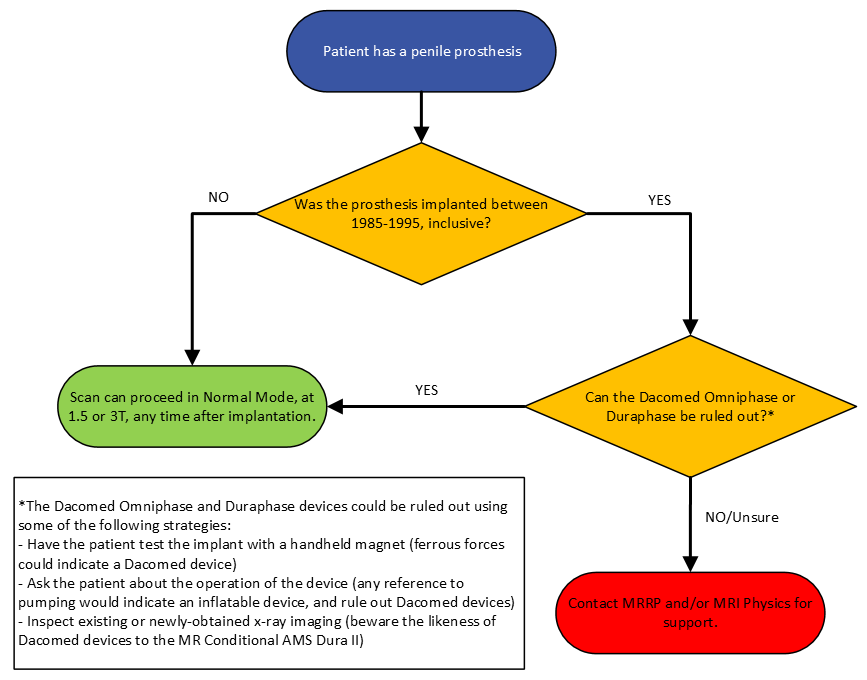
- EXCEPTIONS – The mechanical Dacomed OmniPhase and DuraPhase, implanted between 1986 and around 1995 are not included in this GISP, since they have been shown to experience ferrous interactions with MRI static magnet fields.
- For devices implanted between 1986 and 1995, further investigation is required. The make and model of penile prostheses implanted in this date range should ideally be obtained, or else the Dacomed Omniphase and Duraphase should be ruled out using patient discussion (e.g., mechanism of operation), x-ray imaging or handheld magnet testing.
- It is noted that the Dacomed implants are not considered an absolute contraindication to MRI, since risk mitigation strategies can be employed to counter the risk of ferrous interactions (forces and torques). These cases should risk assessed on a patient-specific basis.
The workflow is shown below and the full policy is here
Acknowledgement
This policy was created by members of the Scottish MRI physics subgroup of the Medical Physics and Clinical Engineering (MPCE) network for NHS Scotland in collaboration with the Scottish MR radiographer leads group.